


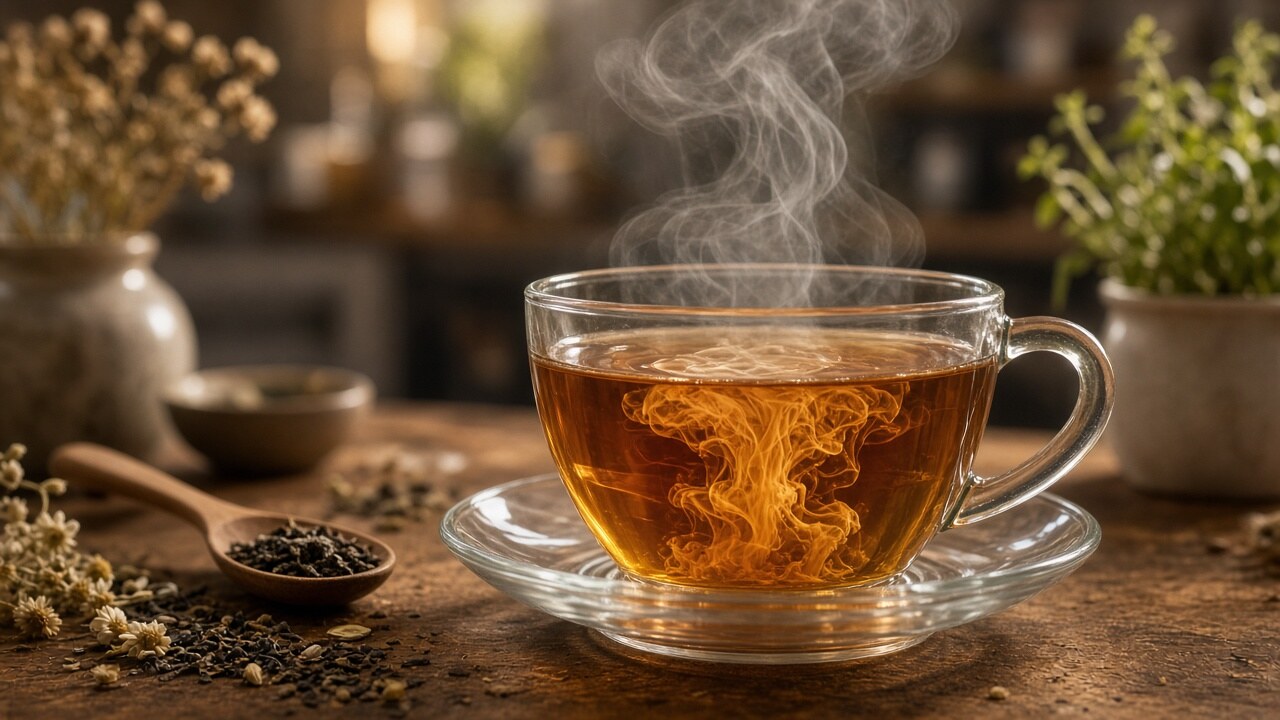
Tea is what happens when heat meets chemistry
A kettle sounds ordinary until you listen as a physicist. Electricity or flame pours energy into water. Molecules move faster. Temperature climbs. At the boiling point, vapor bubbles form, rise, and collapse into steam you can see. That phase change stores and releases energy in ways that make cooking — and burns — possible.
Pouring hot water onto leaves begins extraction. Flavor compounds dissolve and diffuse. Color spreads. Aroma escapes into air. Your cup becomes a temporary reactor with a pleasant outcome.
Everyday objects are often the best science classrooms because they are repeatable, cheap, and already in your routine. Tea is one of them.
Pay attention long enough and ordinary systems reveal the same rules that govern laboratories and landscapes.
Why water boils — and why altitude changes your tea
Boiling happens when vapor pressure inside bubbles matches surrounding pressure. At higher altitudes, air pressure is lower, so water boils at a lower temperature. That is why mountain cooking instructions change: your “boiling” water may be cooler than sea-level boiling water.
For tea and coffee, temperature windows matter. Some delicate teas prefer water below a rolling boil; others tolerate fiercer heat. The physics is the same: molecular motion determines how aggressively compounds leave the leaf.
A lid on a pot raises efficiency by trapping heat and steam. Energy conservation in the kitchen is thermodynamics with snacks.
Nucleation sites on a kettle’s microscopic scratches help bubbles form. Perfectly smooth surfaces can delay boiling — a classic physics demo hiding in cookware.
Diffusion: the invisible stirring
Even without a spoon, tea colors water because particles move from high concentration to low — diffusion. Hotter water speeds this molecular wandering. Stirring adds advection: bulk motion that spreads concentrations faster than diffusion alone.
Watch a droplet of milk bloom in tea and you are seeing fluid dynamics. Swirls stretch into ribbons, then fade into uniformity. Turbulence mixes; viscosity resists. The beautiful patterns are equations made visible.
Cold brew tea slows the same processes. Time replaces heat. Chemistry still happens; the kinetic dial is simply turned down.
If you drop a sugar cube into still tea, you can time how long the plume takes to spread. Change the temperature and repeat. You have just run a diffusion experiment with dessert.
Solubility, oils, and why aroma hits first
Not everything in a leaf dissolves equally. Some compounds love water; others are more at home in oils or vapor. Volatile aromatics escape into air quickly, which is why smell arrives before the first sip finishes telling the story.
Hard water with more minerals can change extraction and mouthfeel. A pinch of chemistry — pH, ions, temperature — alters the drink without changing the leaf brand. That is why the same tea can taste different in two cities.
Sugar dissolving is another lesson: crystals disappear as molecules disperse among water molecules, increasing disorder in a tasty direction.
Cooling cups and the art of not burning your tongue
A hot cup cools by conduction into ceramic, convection into air, and evaporation from the surface. Blowing on tea increases evaporation and replaces the hot boundary layer of air — practical heat transfer. A wider cup cools faster than a tall narrow one because surface area matters.
Microwave heating can create uneven temperatures because water couples to the field differently than the cup. Stirring after microwaving is safety physics, not superstition.
Material choice matters too. Thin metal conducts heat quickly into your fingers; thick ceramic buffers it. Containers are thermal engineering you hold.
A double-walled glass cup slows cooling by trapping an insulating air layer. Industrial thermos flasks push the same idea further with vacuum insulation — kitchen cousins of laboratory dewars.
Tiny lessons that scale to big science
Phase changes in a kettle resemble phase changes in weather and industry. Diffusion in a cup resembles diffusion in cells and semiconductors. Fluid swirls resemble ocean eddies at another scale. Tea does not make you an expert in those fields — it trains intuition for rates, gradients, and energy.
Scientists often use everyday analogies because the universe reuses patterns. Learning to see those patterns is scientific literacy. Your kitchen already has lab equipment: stove, thermometer (even improvised), spoon, timer.
Curiosity is the only reagent you must add.
Once you notice rates and gradients in tea, weather maps and fever charts become less abstract. They are cousins of the same quantitative storytelling.
The takeaway: sip the science
A simple cup of tea hides boiling physics, dissolution, diffusion, aroma chemistry, and cooling laws. You do not need a laboratory coat to meet them — only attention.
For Daily-Feeds readers, that is the charm of everyday science. The universe is not only in particle colliders. Sometimes it is in a mug, steaming, waiting for you to notice.
Next time the kettle clicks off, remember you just watched energy convert into motion, vapor, and the promise of a soluble conversation between leaf and water.







Comments
0 comments