



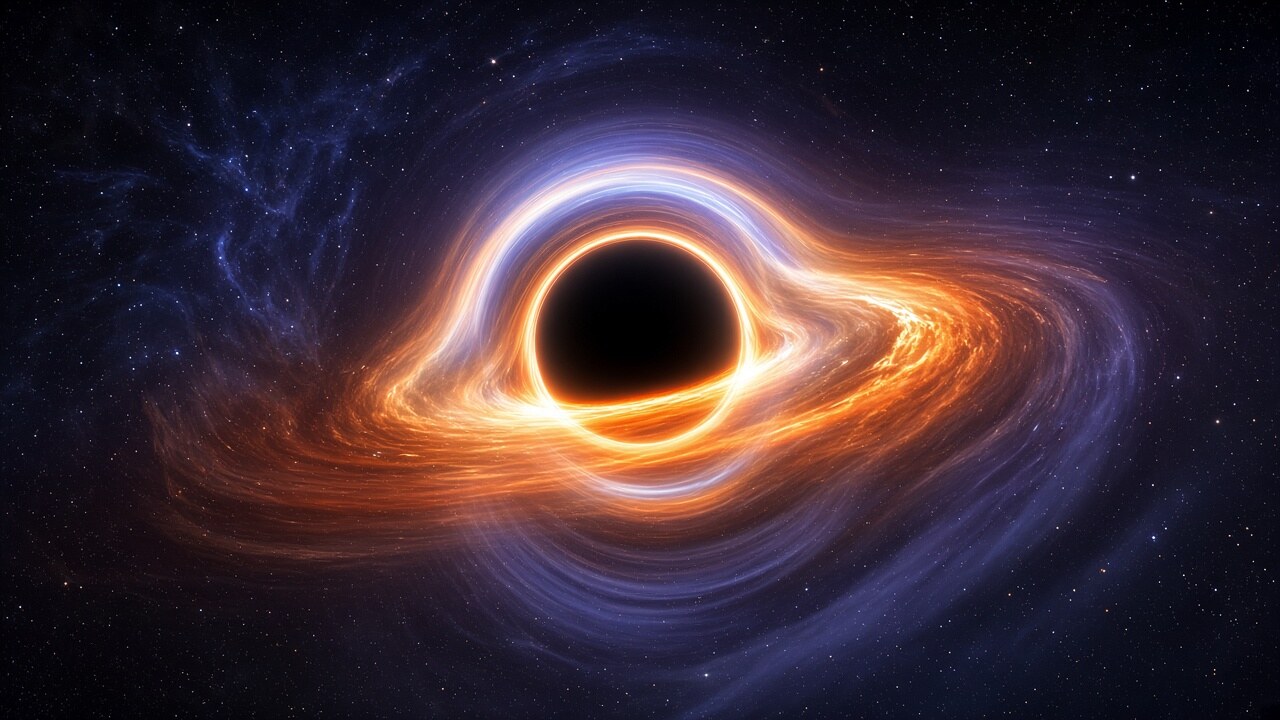
A black hole is gravity taken to an extreme
A black hole forms when enough mass is packed into a small enough region that gravity becomes overwhelming. Collapse can follow a massive star’s death, or rarer events that concentrate matter even further. What remains is not an empty “hole” in the cartoon sense. It is a region of spacetime so curved that, past a boundary called the event horizon, nothing — not even light — can escape to the outside universe.
That idea overturns everyday intuition. We usually think of gravity as a force pulling objects downward. Einstein’s picture is deeper: mass and energy tell spacetime how to curve, and curved spacetime tells matter and light how to move. Near a black hole, that curvature becomes dramatic.
So when headlines say black holes “bend light,” they are describing geometry. Light always travels as straight as spacetime allows. Near a black hole, spacetime itself is so warped that the straightest available paths look curved to distant observers.
Light follows the shape of space
In empty space far from large masses, light rays travel in nearly perfect straight lines. Near the Sun, they bend slightly — enough that star positions shift during a solar eclipse, one of the early tests of general relativity. Near a black hole, the same principle becomes extreme.
Photons can loop, skim, or fall inward depending on their path and energy. Some trajectories form unstable photon orbits outside the event horizon. From afar, these effects help create the glowing ring seen in black-hole images: light from hot gas redirected by curved spacetime into our telescopes.
This is why black holes can act as gravitational lenses. They can magnify and distort background galaxies, sometimes into arcs or multiple images. The black hole is not shining by itself in those cases. It is bending the routes by which other light reaches us.
Time bends too — and that matters
Gravity does not only redirect light. It also affects the flow of time. Closer to a strong gravitational source, clocks tick more slowly relative to clocks farther away. Near a black hole, this gravitational time dilation becomes intense.
To a distant observer, an object approaching the event horizon appears to slow and redshift, its light stretched to longer wavelengths. From the infalling object’s perspective, local physics continues — until tidal forces and the horizon’s one-way nature take over. Popular stories sometimes simplify this into paradoxes; the careful version is about different observers measuring different histories of the same event.
“Bending more than light” is therefore literal. Black holes reshape the stage on which light, matter, and clocks perform. Space and time are both part of the script.
What we can observe without falling in
No probe has returned from inside an event horizon, and none can send a signal out if it crosses one. Yet black holes are not invisible in practice. We infer them from motion: stars whipping around an unseen mass at the galactic center, disks of gas heating as they spiral inward, jets launched from magnetized environments, and gravitational waves from black-hole mergers.
The Event Horizon Telescope’s images of M87* and Sagittarius A* did not photograph a solid surface. They mapped shadow and ring structures shaped by light bent around the near-horizon region. Those pictures are triumphs of both physics and data processing.
Gravitational-wave observatories add another sense. When black holes collide, they send ripples through spacetime that stretch and squeeze detectors on Earth by tiny amounts. We are learning to “hear” the universe’s most violent geometry changes.
Myths that get in the way
Black holes do not roam the galaxy vacuuming everything like cosmic Roomba devices. At a distance, their gravity is like that of any equal mass. If the Sun were replaced by a black hole of the same mass, Earth’s orbit would not suddenly plunge inward; the sky would go dark, but the orbital mechanics would remain similar.
They also do not have a physical “surface” like a planet at the horizon. The event horizon is a boundary in spacetime, not a brick wall. Crossing it is less like hitting concrete and more like passing a point of no return in a current.
Finally, black holes are not portals we understand how to use. Speculative ideas about wormholes appear in theory and fiction, but the astrophysical black holes we observe are better described as endpoints of collapse and engines of extreme environments — not travel stations.
Why black holes matter beyond spectacle
Black holes test physics at its limits. They connect stellar evolution, galaxy growth, and fundamental questions about information, quantum theory, and gravity. Supermassive black holes sit in many galaxy centers and influence how gas flows and stars form across cosmic time.
They also humble our maps of the universe. Much of what we know arrives as light. When gravity can trap or redirect that messenger, astronomy becomes a study of paths as much as sources. Learning to read bent light is learning to read spacetime itself.
For technology and culture, black holes have become a shared symbol of extremes. The science underneath the symbol is more interesting: careful math, patient observation, and a willingness to let nature overturn common sense.
The takeaway: geometry is the real monster
Black holes bend more than light because they bend the arena light travels through. Mass curves spacetime; curved spacetime redirects photons, slows clocks, and creates a one-way boundary where escape ends. What we see from afar — rings, shadows, orbiting stars, gravitational waves — are signatures of that geometry.
For Daily-Feeds readers, the lesson is both cosmic and local: the universe is not only objects in space. It is space and time responding to energy. Black holes are where that response becomes impossible to ignore.




Comments
0 comments